
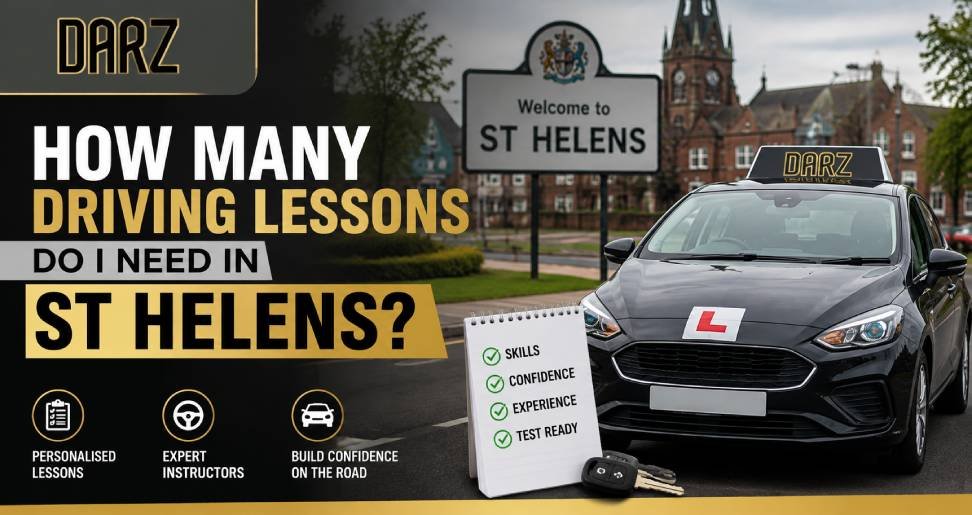
Learning to drive is an exciting step towards greater independence, but one of the first questions most learners ask is: “How many driving lessons do I need in St Helens?” The honest answer is that there is no fixed number. Every learner develops at a different pace, and the number of lessons required depends on previous experience, confidence, lesson frequency, and how much private practice you can complete.
The UK government confirms that there is no minimum number of driving lessons or practice hours required before taking the practical driving test. Instead, you should take your test when you can drive safely and independently without instruction.
For learners preparing around St Helens, local road experience is particularly valuable. The St Helens (Liverpool) test centre recorded a 40.9% car practical test pass rate for April 2025 to March 2026, compared with approximately 50% across Great Britain.
How Many Lessons Does an Average Learner Need?
There is no universal number that guarantees a learner will pass. Some beginners may become test-ready after around 30–40 hours of professional instruction, while others may need 50–60 hours or more.
A completely new driver normally needs time to develop several skills, including:
- Vehicle controls and clutch control
- Moving off and stopping
- Gear changes
- Junctions and roundabouts
- Meeting and passing traffic
- Parking and reversing
- Dual-carriageway driving
- Independent driving
- Hazard awareness
- Understanding road signs and markings
- Test-standard decision making
Your instructor should regularly assess your progress rather than simply recommending a predetermined number of lessons.
Why St Helens Learners May Need Local Road Practice
Learning to drive is about more than controlling the vehicle. You need to respond correctly to different road layouts, traffic conditions, pedestrians, cyclists and unexpected hazards.
St Helens offers a mixture of urban roads, residential streets, junctions, roundabouts and busier traffic environments. This makes local practice important before taking the practical test.
The current St Helens test centre is at 1 Navigation Road, St Helens, WA9 1NS.
Because the recent pass rate is below the Great Britain average, learners should avoid relying only on basic car-control skills. You need to demonstrate consistent, independent decision-making in realistic traffic conditions.
How Your Experience Affects the Number of Lessons
Complete Beginners
If you have never driven before, you will usually need more lessons because everything is new. Your early sessions will focus on basic controls before progressing to more complicated roads.
Taking lessons consistently can help you remember what you learned previously and build skills progressively.
Learners With Some Previous Experience
If you have already driven with a family member or previously taken lessons, you may need fewer professional hours. However, previous experience does not automatically mean you are test-ready.
An instructor may need to correct habits such as poor mirror checks, late signalling, incorrect positioning or hesitation at junctions.
Nervous Learners
Confidence can have a major effect on progress. A nervous learner may understand what to do but struggle to make decisions quickly in traffic.
In this situation, additional lessons can be useful for gradually building confidence rather than rushing towards a test date.
Weekly Lessons or Intensive Driving Lessons?
The best schedule depends on your availability and learning style.
Weekly lessons allow you to spread the cost and gradually develop your skills. However, long gaps between sessions can make it harder to maintain consistency.
An intensive course can provide more frequent practice over a shorter period. It may suit learners who have limited time, need to prepare for an upcoming test or already have some driving experience.
Darz Driving School Manchester offers both regular and intensive learning options, allowing learners to select an approach based on their experience and goals. Its website also lists manual and automatic driving lessons and driving lesson packages.
If you are looking for a faster route to test preparation, a [Manual Driving Crash Course] can be considered where appropriate.
Manual or Automatic: Does It Change the Number of Lessons?
Yes, the type of vehicle can influence how quickly you progress.
Manual Driving Lessons
Manual vehicles require learners to coordinate:
- Clutch control
- Gear selection
- Accelerator control
- Steering
- Braking
- Observation
This can initially make learning more demanding. However, passing your test in a manual vehicle gives you greater flexibility because you can drive both manual and automatic cars.
Automatic Driving Lessons
Automatic vehicles remove clutch and gear-change requirements. This can allow some learners to concentrate more on observation, road positioning, signs and decision-making.
Darz Driving School Manchester provides both [Automatic Driving Lessons] and [Manual Driving Lessons], so learners can choose the option that matches their preferences and future driving needs.
How to Know When You Are Ready for Your Test
Instead of counting lessons, concentrate on your ability to drive independently.
You should be approaching test readiness when you can:
- Drive safely without continuous instructor prompts.
- Complete junctions and roundabouts confidently.
- Maintain appropriate speed.
- Use mirrors effectively.
- Position the vehicle correctly.
- Deal safely with pedestrians and cyclists.
- Complete required manoeuvres consistently.
- Follow road signs and markings.
- Handle different traffic conditions.
- Recognise and respond appropriately to hazards.
The DVSA advises learners to take the practical test only when they can perform the required driving skills without instruction.
Don’t Forget Private Practice
Professional lessons are important, but suitable private practice can help reinforce what your instructor teaches you.
If you have access to an appropriate vehicle and a qualified accompanying driver, additional supervised practice can help you gain experience between lessons.
You could practise:
- Moving off and stopping
- Junctions
- Roundabouts
- Parking
- Reversing
- Residential roads
- Busy town driving
- Dual carriageways
- Independent navigation
Always make sure private practice follows the relevant UK licensing and supervision requirements.
How Darz Driving School Manchester Can Help
Choosing the right instructor can make your learning journey more structured and efficient. A good instructor should identify your weaknesses, explain mistakes clearly and gradually move you towards independent driving.
Darz Driving School Manchester provides professional driving tuition with experienced instructors and offers both manual and automatic options. Its training approach covers basic driving skills, highway and city driving, road-test preparation and other practical driving situations.
Learners who require a more intensive approach can also explore [Crash Course Driving], while those who prefer a traditional learning schedule can choose regular driving lessons.
The important point is not simply completing a particular number of hours. Your lessons should help you become a safe, confident and independent driver.
Frequently Asked Questions
Is there a minimum number of driving lessons in St Helens?
No. The DVSA does not set a minimum number of lessons or practice hours before taking the practical driving test.
Is 20 hours enough to pass?
It can be enough for some learners, particularly those with previous experience and substantial private practice, but it is not enough for everyone. Test readiness should be based on your actual driving ability.
Is 40 hours enough?
Forty hours may be enough for some learners, while others need considerably more. Your instructor should assess your progress and recommend further training where necessary.
Should I take an intensive driving course?
An intensive course can be useful if you want concentrated training or have limited time. However, it is not a shortcut around learning the necessary skills. You still need enough practice to drive safely and independently.
Should I choose manual or automatic?
It depends on your preferences and future requirements. Automatic lessons can simplify vehicle operation, while manual lessons provide broader licence flexibility.
Final Thoughts
So, how many driving lessons do you need in St Helens? There is no single answer. A learner who has never driven before may need significantly more instruction than someone with previous experience and regular private practice.
Rather than choosing a test date based purely on the number of lessons completed, focus on becoming consistently safe and independent. This is particularly important when preparing for the St Helens test centre, where recent published statistics show a pass rate below the Great Britain average.
Whether you choose [Manual Driving Lessons], [Automatic Driving Lessons], regular training or [Crash Course Driving], the right instructor can help you understand where you need improvement and when you are genuinely ready for your test.
If you are looking for structured driving tuition in the Greater Manchester and surrounding areas, Darz Driving School Manchester provides professional manual and automatic driving lessons designed to help learners build confidence and develop safe, practical driving skills.